
Affiliate marketing
Affiliate Marketing Partnerships: How to Pay Partners for Users Who Stay
Affiliate marketing partnerships are deals where a partner, such as a publisher, creator, comparison site or app network, promotes your product and is paid when a defined result happens, like a sale, a sign up or a first deposit. You pay for outcomes, not for exposure. That makes affiliates one of the most measurable channels there is, and one of the easiest to get wrong.

On this page
The whole game is defining the result you pay for, and choosing partners who deliver it. We run affiliate programmes for fintech, gaming, ecommerce and subscription apps, so the examples below come from our own work.
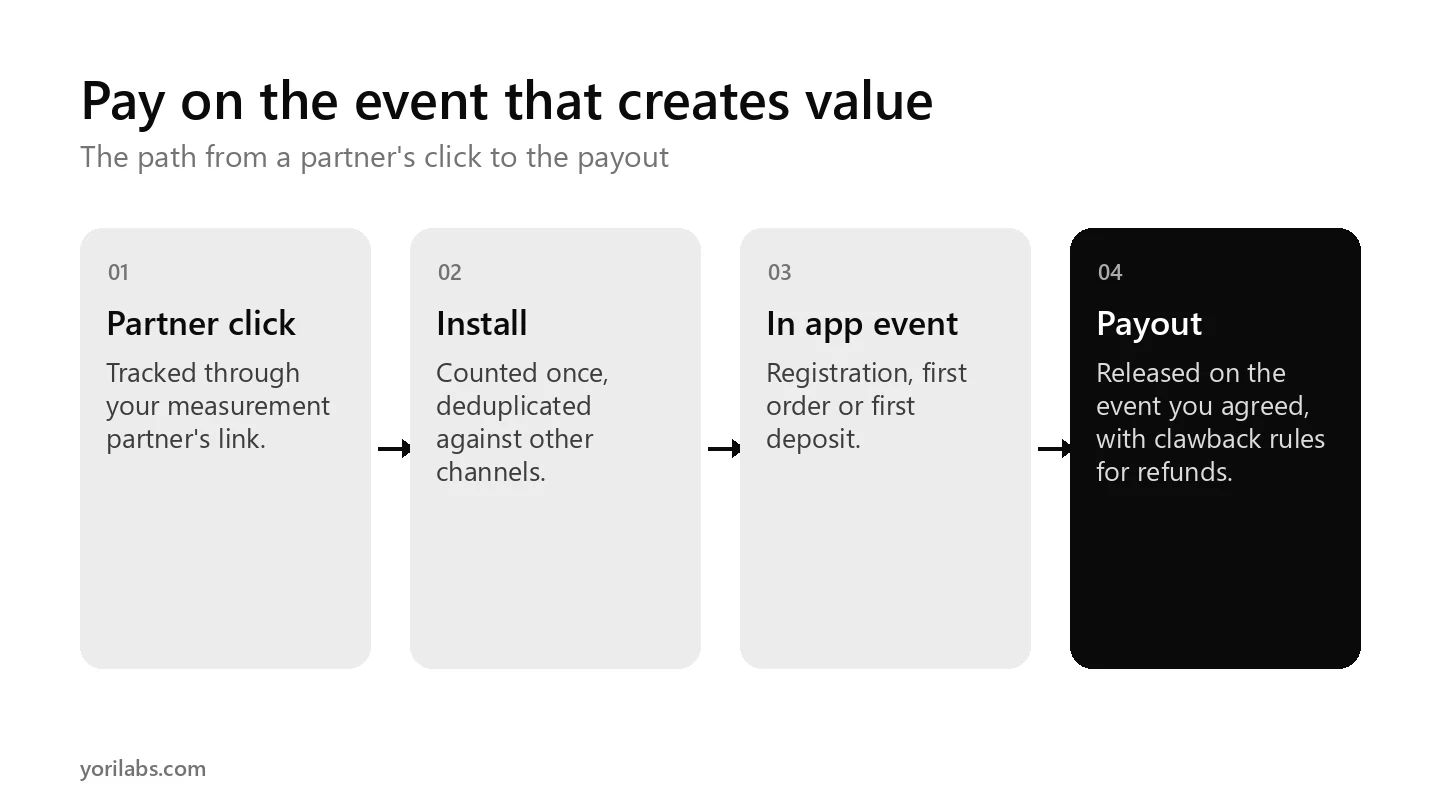
How affiliate partners are paid
| Model | You pay when | Works well for |
|---|---|---|
| CPA or CPS, a flat fee | A sale or sign up happens | Subscriptions, ecommerce |
| Revenue share | The customer generates revenue | Trading, marketplaces, recurring products |
| CPI | An app is installed | Rarely enough on its own, since installs aren't customers |
| CPL | A lead is submitted | Lead generation, with quality checks |
| Hybrid | A base payment plus a bonus for deeper actions | Apps that need activation, not just installs |
Swipe the table sideways to see every column.
The payout model decides which partners show up. Pay for installs, and you attract partners who are good at producing installs. Pay for a funded account, and only partners who can find real customers stay. It's the most important decision in any of your affiliate marketing partnerships.
Two real examples of payout design
Kraken, a crypto exchange: Kraken pays partners a share of the trading fees their referrals generate. Nothing is due on a sign up, or on an account that verifies and then sits idle. The partner earns when the customer trades. For the brand, the right thing to steer by is the funded account that makes its first trade, not the registration. Read the Kraken case study
ExpressVPN, a VPN subscription: ExpressVPN's programme pays a flat amount once, when someone buys, with a money back window under every sale and nothing paid on renewals. A subscriber who stays for years and one who refunds in a week cost the same to acquire. So the budget belongs only with sources whose subscriptions survive the refund window. Read the ExpressVPN case study
Mobile app affiliate marketing: what's different
Apps add three problems that websites don't have.
- Installs aren't customers. Many installs never register, verify or pay, so pay on a deeper event when you can.
- Attribution runs through a mobile measurement partner. Partners must be tracked with proper links, or you'll pay for installs you'd have got anyway. On Android that tracking leans on Google's Play Install Referrer, and on iOS on Apple's AdAttributionKit.
- Install fraud. Fake devices, click spamming and incentivised installs inflate numbers. Watch install to action rates per source, and cut sources whose users never do anything.
How to choose partners for affiliate marketing partnerships
Treat partners like hires, not like inventory.
- Ask where the traffic comes from: content sites, comparison pages, creators, email lists or in app placements.
- Start small with a capped budget and a short test window.
- Judge each source on your business event, not on volume.
- Cut sources that don't convert, even if they're big.
- Check the rules in regulated categories. Finance and other regulated sectors have rules on how products can be promoted, and the brand usually answers for its partners.
InCred Money is an example of the payoff. Rather than accepting whatever an affiliate network delivered, the work looked at where each stream of users came from and kept the sources that sent people with real intent to invest. Read the InCred Money case study
And Shiprocket shows the volume side. An affiliate led, partner driven programme accelerated its mobile user acquisition, with partners chosen to add reach rather than duplicate it. Read the Shiprocket case study
A setup checklist
- Define the paid event precisely, for example a first deposit within 30 days of install.
- Set up tracking: affiliate platform or measurement partner links, with deduplication against other channels.
- Write the terms: allowed traffic sources, banned methods such as incentivised installs or brand bidding, and refund and clawback rules.
- Approve partners individually.
- Review weekly: results per source, install to action rates and refunds.
- Scale the sources that hold up, and remove the rest.
Do you run traffic yourself? You can apply to be a Yori Labs partner.
Signs a partner isn't working
- Lots of installs or sign ups, but almost no deposits, orders or subscriptions behind them.
- Traffic that arrives in sudden spikes at odd hours.
- Users who all come from the same few devices or locations.
- Refund or chargeback rates well above your other channels.
When you see these, pause the source, ask the partner where the traffic came from, and only restart it if the answer and the data both hold up.
Frequently asked questions
What is an affiliate marketing partnership?
It's an arrangement where a partner promotes your product and is paid when a defined result happens, such as a sale, a sign up, a first deposit or a share of revenue. The partner might be a publisher, a creator, a comparison site or an app network. You pay for outcomes rather than for exposure.
How do affiliate partners get paid?
Usually per action, with a flat fee per sale or sign up, as a revenue share, per lead or per install, or a mix of these. The right model depends on which customer action creates value for your business. Paying on a deeper event attracts partners who can find real customers.
How does affiliate marketing work for mobile apps?
Partners promote the app with tracked links through a mobile measurement partner. The best programmes pay on in app events like a registration, a first order or a first deposit rather than installs, and they check each source for fraud by comparing how many installs go on to take that action.
How do I stop affiliate fraud?
Pay on deeper events, track every source separately, and compare install to action rates by source. Write clawback rules for refunds and invalid traffic into your terms, and cut sources whose users never act. Fraud tends to show up as lots of installs with almost nothing happening after them.
Are affiliate partnerships cheaper than ads?
They can be, because you pay for outcomes. But a badly defined outcome or weak partner checks can make them expensive, since you may pay for users who never stay. Judge affiliates on the same business event and payback rules as your other channels, then compare them fairly.
Want an affiliate programme that pays for real users?
We design and run affiliate programmes for fintech, gaming, ecommerce and subscription apps, with payouts tied to the event that pays. If you'd like help setting one up or cleaning one up, and we'll suggest what to change.
tell us how yours works today