
Performance marketing basics
What Is Performance Marketing? A Plain Guide with Real Examples
What is performance marketing? It's advertising you judge by measurable results. Instead of paying to be seen and hoping it works, you track every action an ad produces, such as a click, a lead, an app install or a sale, and you put more money only where those actions come in at a cost the business can afford.

On this page
That's the whole idea. The rest is detail: which channels you use, how you pay and what you measure. We're Yori Labs, and this is the plain version we give new clients on day one.
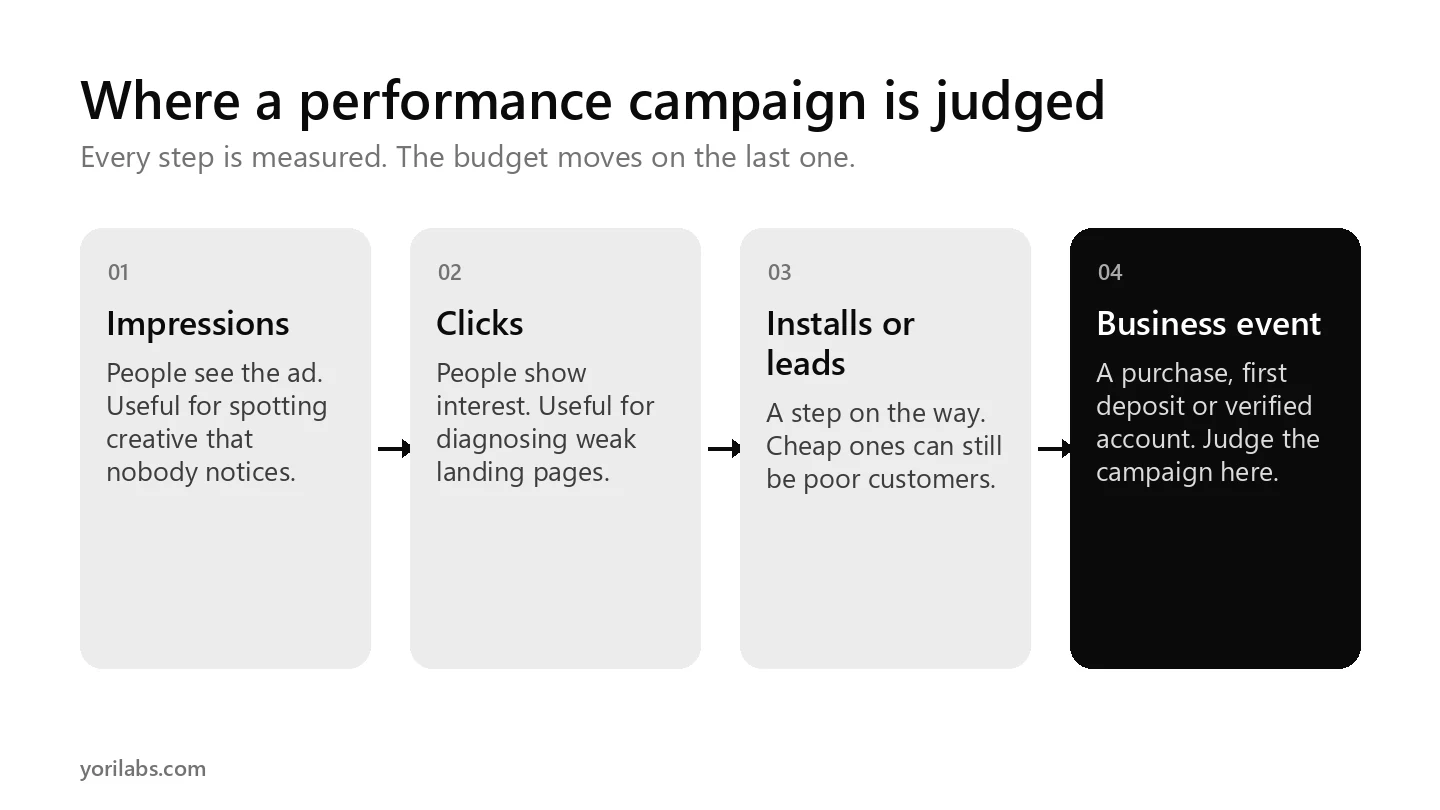
What is performance marketing, step by step
- Pick the business event that matters. For an online store that's a purchase. For a trading app it's a funded account. For an insurance app it's a policy booked. Installs and clicks are steps on the way, not the goal.
- Track that event. Ad platforms can only optimise toward what they can see, so the event has to be measured, with a pixel such as the Meta Pixel or Google Ads conversion measurement on a website, or a mobile measurement partner inside an app.
- Run ads where results can be measured. Search, social, app stores, programmatic and affiliate partners all report results.
- Test. Try different audiences, creatives and offers side by side.
- Move the budget. Spend more on what produces the business event at a good cost, and cut what doesn't.
Repeat the last two steps every week. Performance marketing is less a campaign than a habit of moving money toward evidence.
The main channels
- Search ads, such as Google Ads, including App campaigns for app installs. People are already looking for something, so intent is high.
- Social ads on Meta (Facebook and Instagram), TikTok and Snapchat. They reach people who aren't searching yet, with strong targeting and creative formats.
- App store ads, such as Apple Ads, shown inside App Store search results.
- Programmatic and connected TV: buying ad space across many apps and sites through automated platforms. Our page on working with a programmatic advertising agency explains how that buying works.
- Affiliate and publisher partnerships: partners promote your offer and are paid when a result happens.
How it's priced
| Model | What you pay for | Where you see it |
|---|---|---|
| CPM | Every 1,000 impressions | Most social and programmatic buying |
| CPC | Each click | Search ads, some social ads |
| CPL | Each lead | Lead generation deals, some partners |
| CPI | Each app install | App install campaigns and networks |
| CPA | Each completed action, such as a sale or deposit | Affiliate deals, and as a target in bidding |
| Revenue share | A share of the sale | Affiliate programmes |
Swipe the table sideways to see every column.
One thing that confuses people: most ad platforms bill you for impressions or clicks, even when you bid toward a cost per action. Cost per acquisition is usually something you calculate and optimise for. Paying strictly per outcome is more common with affiliates and some partner networks.
Performance marketing vs digital marketing and brand marketing
Digital marketing is the umbrella: SEO, content, email, social media and paid ads. Performance marketing is the paid part that's judged on measurable actions. Brand marketing sits beside it.
| Performance marketing | Brand marketing | |
|---|---|---|
| Goal | A measurable action now | Being remembered and trusted over time |
| Measured by | Cost per lead, install or purchase, and payback | Reach, recall and share of search |
| Time to signal | Days to weeks | Months |
| Typical channels | Search, social, app stores, affiliates | TV, video, sponsorships, PR |
Swipe the table sideways to see every column.
They aren't enemies. Strong brands usually make performance ads cheaper, because people click and convert more readily on names they already know.
What to measure, and what to ignore
The right number is the first business event after the click or install: a purchase, a first deposit, a verified account or a paid subscription. Track the cost of that event, not just the cost of the install.
Then look one step further:
- Payback: how long it takes for a customer's revenue to cover what you paid to acquire them.
- Quality: do these users come back, deposit again and order again?
- Clean data: filter invalid and fraudulent traffic before you judge a channel, or you'll scale the wrong thing.
Impressions, clicks and installs are useful for diagnosing problems. They're poor targets on their own.
Performance marketing examples from our case studies
- ACKO, an insurance app: acquisition was optimised toward policy bookings rather than installs. The result was 5 lakh app installs and more than 550 policies booked in 45 days. Read the ACKO case study
- Vance, a cross border payments app: Google Ads optimisation led to 3x lower customer acquisition cost and 5x growth. Read the Vance case study
- Tide, a business banking app: month on month optimisation produced a 37.5% rise in app installs and more than 10,000 accounts opened. Read the Tide case study
In each case, the campaign was judged on the business event, such as policies, customers or accounts, not on clicks.
What is performance marketing good for, and when does it struggle?
It's a good fit when the action you want can happen and be tracked online, when you can set up conversion tracking properly, and when you have budget to test before you scale.
It struggles when you're creating a new category nobody searches for yet, because you'll need some awareness first. It also struggles when the sale happens offline weeks later and can't be connected back to the ad.
Frequently asked questions
Is performance based marketing the same as performance marketing?
Yes. Performance based marketing is another name for the same idea: advertising that's judged, and often paid for, on measurable results such as leads, installs or sales. Some people use it more narrowly for deals where you only pay when a result happens, which is common with affiliates and partner networks.
Which channels are used for performance marketing?
Mainly search ads, social ads on Meta, TikTok and Snapchat, app store ads such as Apple Ads, programmatic and connected TV, and affiliate partnerships. The common thread is that each one reports results you can tie back to spend, so budget can move toward whatever produces the business event at a good cost.
How do you pay for performance marketing?
Most ad platforms charge for impressions or clicks, and you judge results by the cost of each lead, install or purchase you work out from your own data. Affiliates and some partner networks are paid per outcome instead. Whatever the billing model, set your target on the business event, not on clicks.
What should an app measure in performance marketing?
The first business event after the install, such as a first deposit, an order, a verified account or a subscription, and the cost of each one. Then track payback, which is how long a user takes to cover their acquisition cost. Installs and clicks help you diagnose problems, but they're weak targets on their own.
Can a small business do performance marketing?
Yes. Start with one channel and one conversion that's tracked properly, test with a small budget for a few weeks, and only scale what pays back. Small budgets need patience, because ad platforms learn from conversions, so pick an event that happens often enough for the system to see it.
Want your ads judged on the event that pays?
We're a performance marketing agency for fintech, gaming, ecommerce and subscription apps, and we judge every campaign on the business event, not on installs. If that's how you'd like your budget run, and what you'd count as a result.
tell us about your app