
User acquisition basics
User Acquisition Meaning: How Apps Win Users Who Stay
Here's the user acquisition meaning in one line: getting new users for an app or digital product, through paid ads, app store search, referrals and partnerships. In practice, good user acquisition isn't about the number of installs. It's about how many of those people go on to use, pay and stay, and what each one cost you.

On this page
We run user acquisition for fintech, gaming, ecommerce and subscription apps, so this guide sticks to what we see in real accounts.
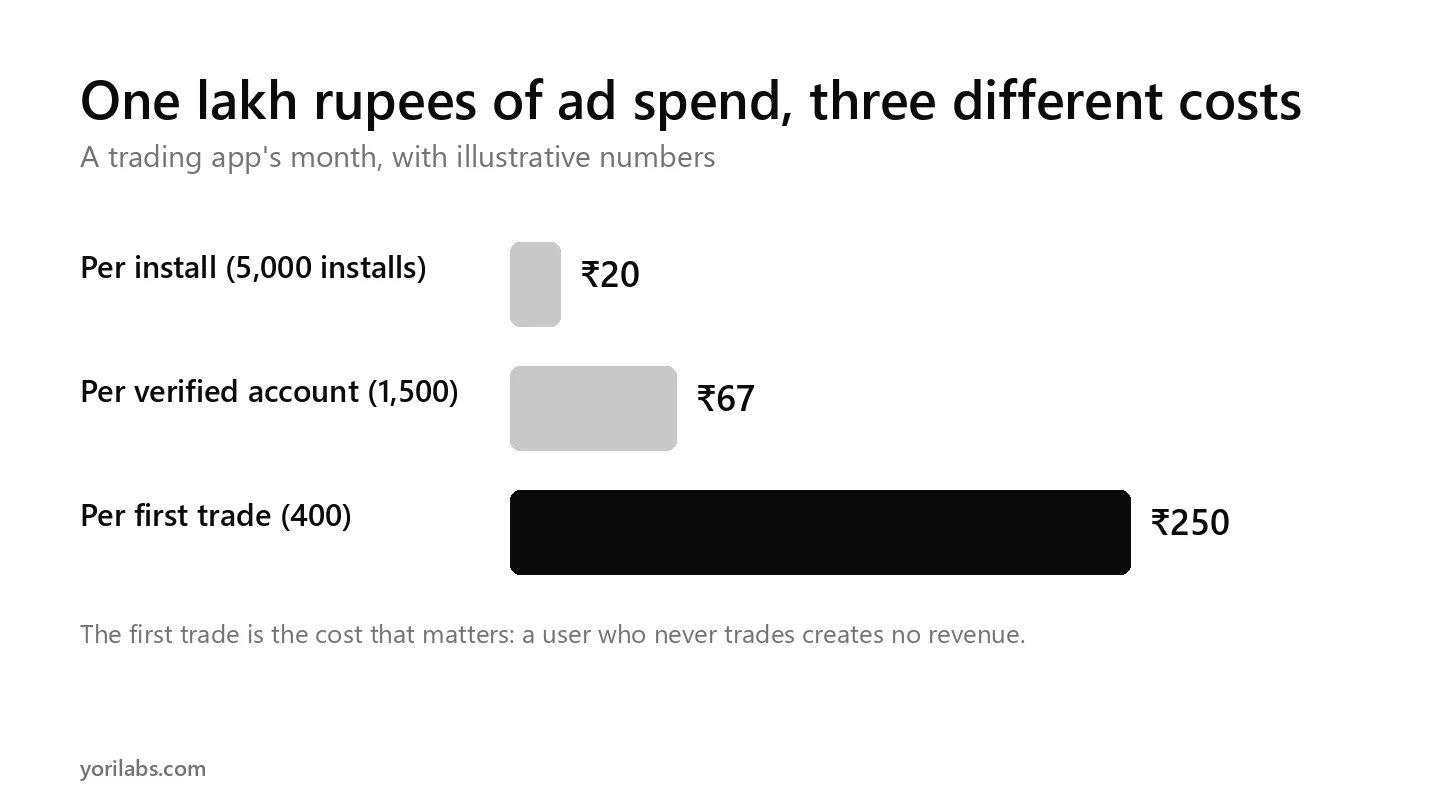
The user acquisition meaning, in one example
A trading app spends ₹1,00,000 on ads in a month.
- Installs: 5,000 people install it.
- Verified accounts: 1,500 complete KYC.
- First trade: 400 make their first trade.
So the cost is ₹20 per install, about ₹67 per verified account and ₹250 per first trade.
Which one is the user acquisition cost? For this business it's ₹250, because a user who never trades doesn't create revenue. These numbers are illustrative, not from a real campaign, but the pattern is one we see all the time.
The main channels
- Paid ads: Meta, Google including App campaigns, Apple Ads, TikTok, Snapchat and programmatic networks.
- App store optimisation: better titles, screenshots and ratings, so more people who find the app in the store install it.
- Referral programmes: existing users invite new ones.
- Affiliates and partners: publishers or creators promote the app and are paid per result.
- Content and community: search traffic, social media and YouTube that send people to the app over time.
Paid and organic work together. Strong paid campaigns often lift organic installs too, because the app ranks better and more people hear about it.
The metrics that matter
| Metric | What it means | Simple formula |
|---|---|---|
| CPI, cost per install | What one install costs | Ad spend ÷ installs |
| CPA, cost per action | What one key action costs, such as a first order | Ad spend ÷ actions |
| CAC, customer acquisition cost | What one paying customer costs | Acquisition spend ÷ new paying customers |
| Retention on day 1, 7 and 30 | Share of users still active after that many days | Active users on day N ÷ installs |
| LTV, lifetime value | Revenue a user brings over their life with you | Average revenue per user over time |
| Payback period | How long until a user's revenue covers their cost | Time until LTV is at least CAC |
Swipe the table sideways to see every column.
A simple rule: scale a channel only when CAC is comfortably below LTV, and payback fits your cash flow.
Why installs can mislead you
An install is the start of the journey, not the end. Many installs never register, and many registrations never verify or pay. If a campaign is optimised only for installs, the ad platform finds people who install cheaply, who may be the people least likely to pay.
That's why experienced teams optimise for a deeper event, such as a completed registration, a verified account, a first order or a first deposit, once there's enough volume to do so.
What changed on iOS
Apple's App Tracking Transparency framework means apps must ask permission before tracking people across other companies' apps and websites. Many people say no, so measuring iOS campaigns relies more on Apple's privacy preserving attribution, such as AdAttributionKit, and on modelling. Plan iOS campaigns expecting less detailed data than on Android.
How to build a user acquisition strategy
- Define the event that counts: an order, a deposit, a verified account or a subscription.
- Fix tracking first: set up a mobile measurement partner and check its numbers against your back end.
- Fix the funnel: a slow sign up or a broken OTP step wastes every rupee of ad spend.
- Test two or three channels with small budgets, judged on the event you defined.
- Refresh creative often. Ads tire faster than most teams expect.
- Filter bad traffic before judging a source.
- Scale what pays back, one channel at a time.
Real examples
- Equal AI: fixing the one time password journey lifted verified users by 31%, with more people finishing verification and no bigger media bill. Sometimes the best fix is inside the app. Read the Equal AI case study
- DealShare: spend was steered toward people new to the platform, and half of the users acquired were new. Read the DealShare case study
That's the practical user acquisition meaning: users who reach the event that pays, at a cost that pays back. If you'd rather hand it to a team, our page on working with an app growth agency explains how we run it, and our guide to the best user acquisition agencies compares the options.
Frequently asked questions
What is the meaning of user acquisition?
User acquisition is the process of getting new users for an app or digital product, through paid ads, app store search, referrals, partnerships and content. Done well, it's measured on the users who go on to register, verify, pay and stay, not on installs alone, and on what each of those users cost you.
What is user acquisition cost?
It's what you spend to gain one new user or customer. The most useful version divides acquisition spend by new paying customers, not by installs, because an install that never pays doesn't create revenue. Many teams track both, but they make scaling decisions on the cost of the paying customer.
What is the difference between CPI and CAC?
CPI is the cost of one install. CAC is the cost of one paying customer. CAC is almost always higher, because only some installs ever pay, and it's the better guide for deciding where to scale. A channel with cheap installs can still have an expensive CAC if those users don't convert.
What is a user acquisition strategy?
It's a plan for which channels to use, which event to optimise for, how to measure it, and when to scale or cut a channel based on payback. It's the paid growth core of a wider mobile app marketing strategy, which also covers app store optimisation, onboarding and retention work.
Is user acquisition only paid advertising?
No. It also includes app store optimisation, referrals, partnerships and content. Paid ads are usually the fastest lever because you can turn them up or down within days, but the strongest growth plans mix paid and organic channels, since each one tends to make the other work better.
Want users who reach the event that pays?
We plan and run user acquisition for fintech, gaming, ecommerce and subscription apps, judged on deposits, orders and verified accounts rather than installs. If you'd like a second opinion on your funnel, and we'll look at it with you.
tell us where it leaks