
AI agents explained
AI Agent vs Agentic AI: What's the Difference?
AI agent vs agentic AI is a question we hear every week. An AI agent is software that uses AI to carry out a specific task, such as answering a support question or following up a lead. Agentic AI is the wider system: it takes a goal, plans the steps, and coordinates several agents and tools to reach it with limited human supervision.

On this page
Put simply, agents are the workers, and agentic AI is the team that organises the work. The two terms are used loosely, and vendors don't all define them the same way, so here's how three major companies describe the difference, and what it means for a business.
How Google, IBM and Palo Alto Networks define it
- Google Cloud describes AI agents as the building blocks of agentic AI in its explainer on what agentic AI is. An agent may focus on one task, while agentic AI uses several agents together to handle complex workflows and coordinates them toward a broader objective.
- IBM describes agentic AI as a system that can accomplish a specific goal with limited supervision. It's made up of AI agents, each handling a subtask, coordinated through orchestration.
- Palo Alto Networks frames AI agents and agentic AI differently: agents are task oriented and act on triggers and instructions, while agentic AI is goal oriented, reasons, makes plans and coordinates tools or sub agents.
The common thread: an agent does a task, and agentic AI pursues a goal. These are our summaries of their definitions, not quotes.
AI agent vs agentic AI, side by side
| AI agent | Agentic AI | |
|---|---|---|
| Scope | One task or a narrow set of tasks | A whole goal or workflow |
| Starts from | A trigger or an instruction | A goal |
| Planning | Follows defined steps | Breaks the goal into steps and adjusts them |
| Tools | Uses the tools it's given | Chooses and coordinates several tools and agents |
| Human role | Sets up the task and reviews output | Sets the goal and the limits, and reviews key decisions |
| Example | A bot that answers delivery questions | A system that handles a support case from question to refund |
Swipe the table sideways to see every column.
A business example: sales follow up
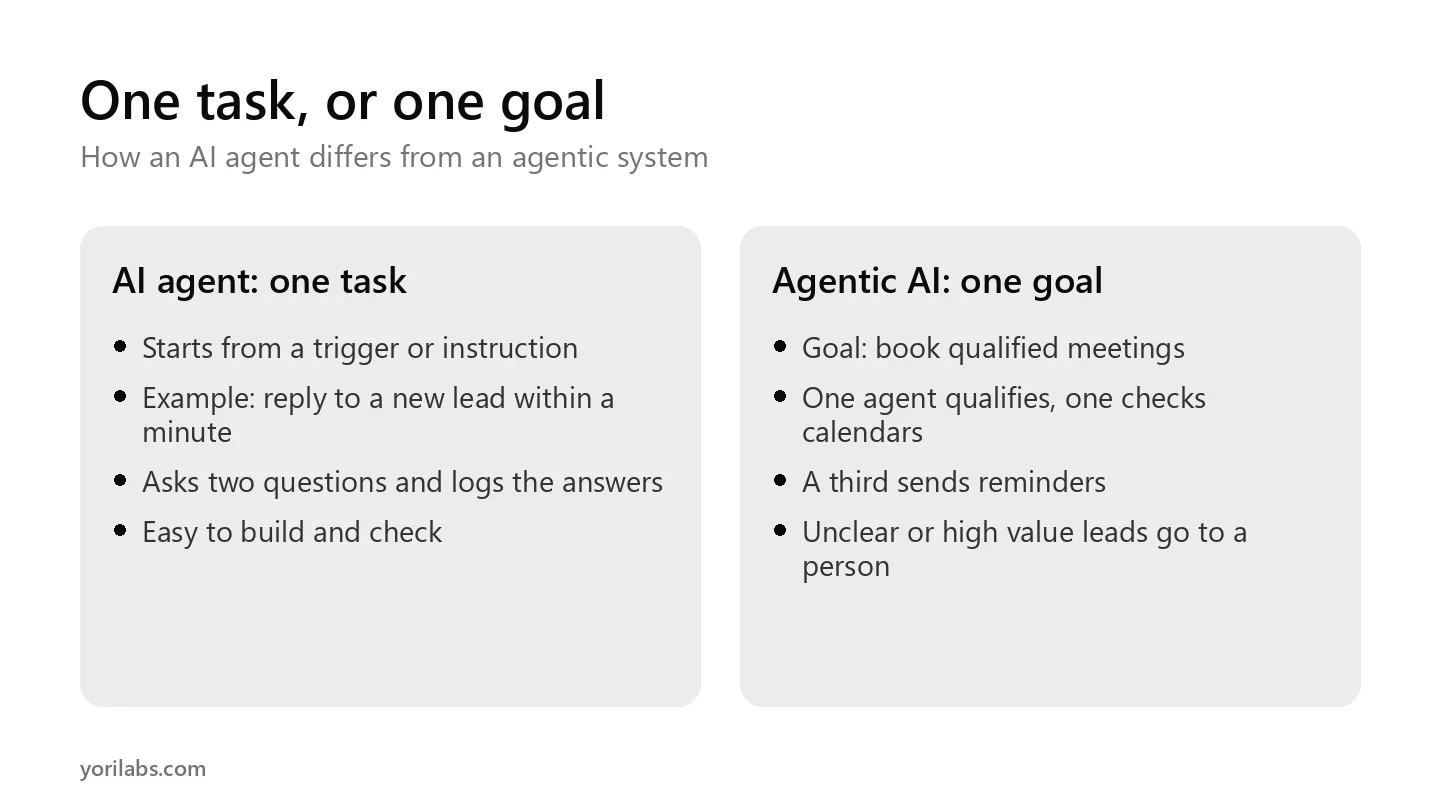
With an AI agent: a new lead fills in a form. An agent sends a WhatsApp or email reply within a minute, asks two qualifying questions and logs the answers in the CRM. It's one task, done well.
With agentic AI: the goal is "book qualified meetings". The system does several things.
- One agent qualifies the lead.
- Another checks the salesperson's calendar.
- A third sends reminders.
- Leads that are high value or unclear go to a human.
- Over time, it learns which follow up timing gets more replies.
Several agents, one goal. Our AI agents for sales, support, social and internal operations follow this second pattern: a signal arrives, the agent decides, it acts, and the work closes.
Which one does your business need?
- Start with a single AI agent when the task is clear and repetitive, such as first replies to leads, FAQ answers or order status questions. It's faster to build and easier to check.
- Move to agentic AI when the work crosses several steps and tools, and the steps change case by case, such as qualifying, scheduling and following up leads.
- Keep a human in the loop for decisions that cost money, touch customer data or can't be undone. More autonomy means you need clear limits and logging.
If you're starting smaller, our guide to AI automation covers simpler workflows, and our comparison of n8n alternatives shows the tools many teams build them with.
Common misunderstandings in the AI agent vs agentic AI debate
- "Agentic AI is just a smarter chatbot." A chatbot answers. An agentic system plans and acts across tools.
- "More agents is always better." Each extra agent adds cost and points of failure. Use the simplest setup that does the job.
- "Agentic means no humans." Good agentic systems are designed with checkpoints where people approve or correct.
What it costs to run either one
Both run on AI models that are billed by use, so costs rise with every message, step and tool call. A single agent answering new leads might make a few model calls per conversation. A system with three or four agents can make many more for the same lead, because each one reads, decides and hands over.
So measure cost per completed task, not cost per month, and compare it with what the same task costs when a person does it. If the agentic version isn't clearly cheaper or better, the simpler setup wins.
Frequently asked questions
What is the difference between an AI agent and agentic AI?
An AI agent carries out a specific task, such as replying to a lead or answering a support question. Agentic AI pursues a goal by planning the steps and coordinating several agents and tools with limited human supervision. In short, agents are the workers and agentic AI is the system that organises their work.
Is an autonomous AI agent the same as agentic AI?
Not exactly. An autonomous AI agent is a single agent that can take steps toward its task with little human input. Agentic AI is the wider system: it pursues a goal and can coordinate several agents and tools along the way. An autonomous agent can be one part of an agentic system.
Is ChatGPT an AI agent?
On its own, a chat assistant answers questions. When it's connected to tools and allowed to take actions toward a task, such as searching, filling in forms or sending messages, it starts acting as an agent. What makes something an agent is that it acts, not just that it answers.
Is agentic AI the same as generative AI?
No. Generative AI creates content such as text and images. Agentic AI uses models, often generative ones, to plan and act toward a goal across tools and steps. You can think of generative AI as one ingredient an agentic system uses, alongside tools, data and rules.
Do I need agentic AI or just one AI agent?
Start with one agent for a clear, repetitive task, such as first replies to leads or order status questions. Move to agentic AI when the work spans several steps and tools that change from case to case. Either way, keep a person in the loop for decisions that cost money.
Want an AI agent that closes the loop?
We build AI agents for sales, support and operations, alongside our performance marketing work for fintech, gaming, ecommerce and subscription apps. If there's a repetitive job you'd like off your team's plate, and we'll suggest where to start.
tell us what it is