
Competitor research
Meta Ads Library: How to See, and Learn from, Any Competitor's Ads
The Meta Ads Library is Meta's free, public search tool for ads running on Facebook, Instagram and Meta's other platforms. Anyone can use it, without an account and without advertising. Search a brand's name or Page and you'll see the ads it's running right now, with the creative and the date each one started.

On this page
It's the quickest legitimate way to see what competitors are testing. We use it every month for the fintech, gaming, ecommerce and subscription apps we work with. Here's how to use it, and what it won't tell you.
How to search the Library, step by step
- Go to the Meta Ad Library on facebook.com.
- Choose a country, for example India. Ads are shown for the country you pick.
- Set the ad category to All ads. Other options include issues, elections or politics.
- Type a brand name, Page name or keyword, and pick the advertiser from the list.
- Use filters such as platform, media type and active status.
- Click See ad details on any ad for more information, such as the advertiser's details or the questions in a lead form.
What the Meta Ads Library shows, and what it hides
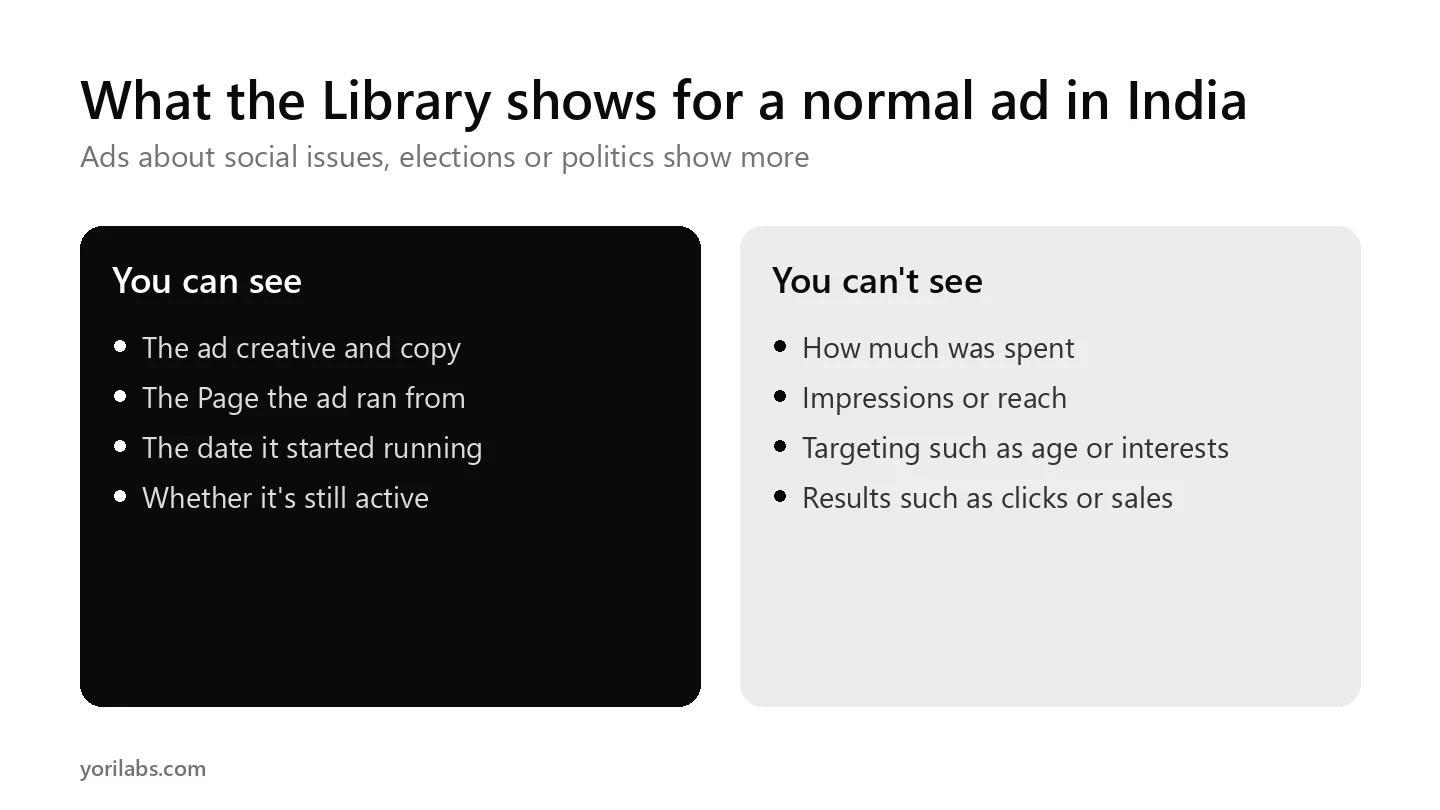
For a normal commercial ad in India, one that isn't about politics or social issues, Meta's page about the Meta Ad Library describes what's shown.
| You can see | You can't see |
|---|---|
| The ad creative and copy | How much the advertiser spent |
| The Page the ad ran from | Impressions or reach |
| The date the ad started running | Targeting such as interests, age or location |
| Page transparency details, such as name changes | Results such as clicks or sales |
| Whether the ad is active | Inactive ads, because normal ads aren't archived |
Swipe the table sideways to see every column.
Ads about social issues, elections or politics are different. They're stored for 7 years, and they show spend ranges, impressions and reach breakdowns. Ads delivered in the EU or the UK are archived for one year after their last impression, with reach and basic targeting data.
The Library also includes active branded content marked with a paid partnership label on Facebook and Instagram, which is useful for spotting creator deals.
How to use it for competitor research
- Count active ads per competitor. Many live variations usually means they're actively testing creative.
- Look at start dates. An ad that's been running for months is probably working, since brands don't keep paying for losers. It's a signal, not proof.
- Collect hooks. Note the first line of copy and the first 3 seconds of videos, then group them by theme: price, proof, fear of missing out or how to.
- Check formats. Look at the mix of reels style video, carousels and static images. Copy the mix, not the creative.
- Read the landing pages. Click through to see offers, pricing and sign up flows.
- Check lead forms. See ad details on lead ads can show which questions competitors ask.
- Repeat monthly. The value is in the trend: what they stopped running, and what they scaled.
Don't copy competitor ads or claims. Use the Library to understand angles and formats, then make your own. Copying creative can breach copyright and Meta's advertising policies.
A 20 minute monthly routine
Here's the routine we'd suggest for a small team. Pick three to five competitors and one adjacent brand you admire. For each one, screenshot the ads that started this month and the ads that have run longest. Write one line per ad on the angle it uses.
At the end, you'll have a short list of angles your market is testing, and a few that seem to last. That list is a far better brief for your next creative round than a blank page. Pair it with what you know about Instagram ads interests, and you'll have both the who and the what of your next test.
Meta Ads Library vs Google Ads Transparency Center
Google has a similar public tool for ads on Search, YouTube and its display network. Our guide to the Google Ads Transparency Center explains how to use it. Use both: many brands run different messages on Meta, where people discover, and on Google, where people search with intent.
If you'd rather have someone run this research and the campaigns it feeds, here's how to choose a performance marketing agency.
Frequently asked questions
What is the Meta Ads Library?
It's Meta's public, searchable database of ads running across Facebook, Instagram and Meta's other platforms. Anyone can view it for free, without an account. You can search by brand, Page or keyword, filter by country, platform and media type, and open each ad's details to see who's running it and since when.
Can I see how much a competitor spends in the Meta Ads Library?
Not for normal commercial ads in India. Spend, impressions and reach are shown only for ads about social issues, elections or politics, which are kept for 7 years. For ordinary brand ads you'll see the creative, the Page and the start date, so you have to infer effort from how many ads run.
Do I need a Facebook account to use the Meta Ads Library?
No. Anyone can view and search the Library, whether or not they have a Facebook or Instagram account, and whether or not they advertise. You just choose a country, pick an ad category and type a brand name, Page name or keyword. It's free, and there's no limit on how often you can look.
Does the Meta Ads Library show old ads?
For normal ads, it shows active ads only, so once an ad stops it disappears. Ads about social issues, elections or politics are kept for 7 years, and ads delivered in the EU or the UK are kept for one year after their last impression. Screenshot anything you want to keep.
Is the Facebook Ads Library the same as the Meta Ads Library?
Yes. It was called the Facebook Ad Library and now sits under the Meta name, covering Facebook, Instagram and Meta's other platforms. The address on facebook.com still works, and the search, filters and ad details are the same tool. People simply use both names for it.
Want competitor research turned into campaigns?
We research, plan and run Meta campaigns for fintech, gaming, ecommerce and subscription apps, and judge them on the business event rather than clicks. If you'd like a fresh read on your market's ads, and we'll take a look.
tell us who you compete with