
Government tenders guide
How GeM Seller Registration Works for Agencies and Small Businesses
The government is the biggest buyer in India, and most of its shopping now happens on one website. That site is GeM, the Government e Marketplace, and GeM seller registration is how a small business gets onto it. We're Yori Labs, an advertising agency, and we're registering our own companies on GeM right now. This guide is what we wish we'd had on day one: who can register, what to keep ready, the three stages on the portal, and the catches nobody puts in the reels.

On this page

Here's the short version. You'll need your PAN or Aadhaar, a bank account and, for orders above ₹2.5 lakh, a GST number. You don't need a big turnover to sign up. You'll need one later, for the larger bids.
What GeM is and why small businesses should care
GeM is where central ministries, state departments and public sector companies buy goods and services, from laptops and chairs to cleaning, catering and, more and more, marketing. In the financial year that ended in March 2026 it crossed ₹5 lakh crore of orders, according to the Commerce Ministry.
The part that matters for a small business is a rule from 2012. The Public Procurement Policy for Micro and Small Enterprises sets an annual target for central ministries and public sector companies: buy at least 25% from micro and small enterprises. In practice they did better than the rule. Micro and small enterprises won 47.1% of the value of GeM orders last year, and 68% of the orders themselves.
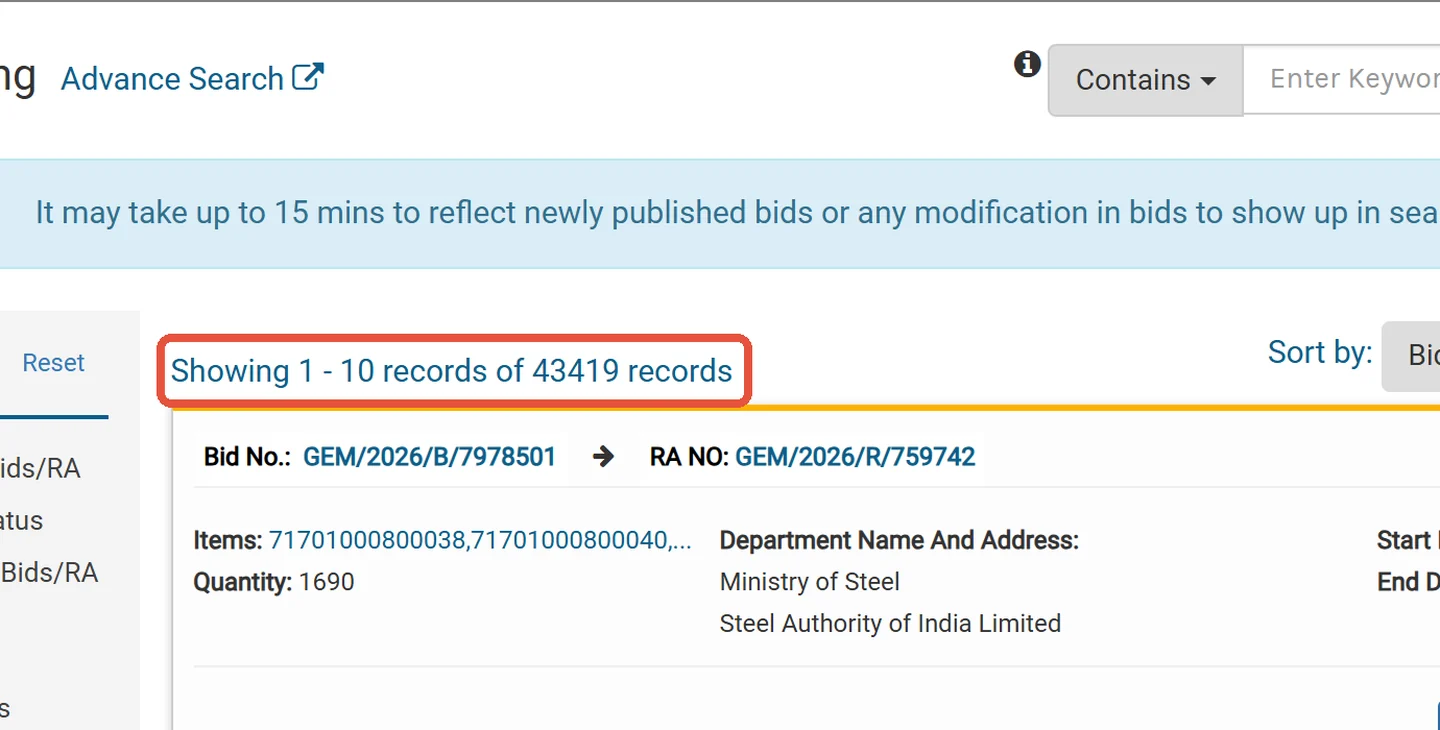
There's no shortage of work to look at, either. When we checked on 29 October 2026, there were 43,419 live bids on GeM's bid listing.
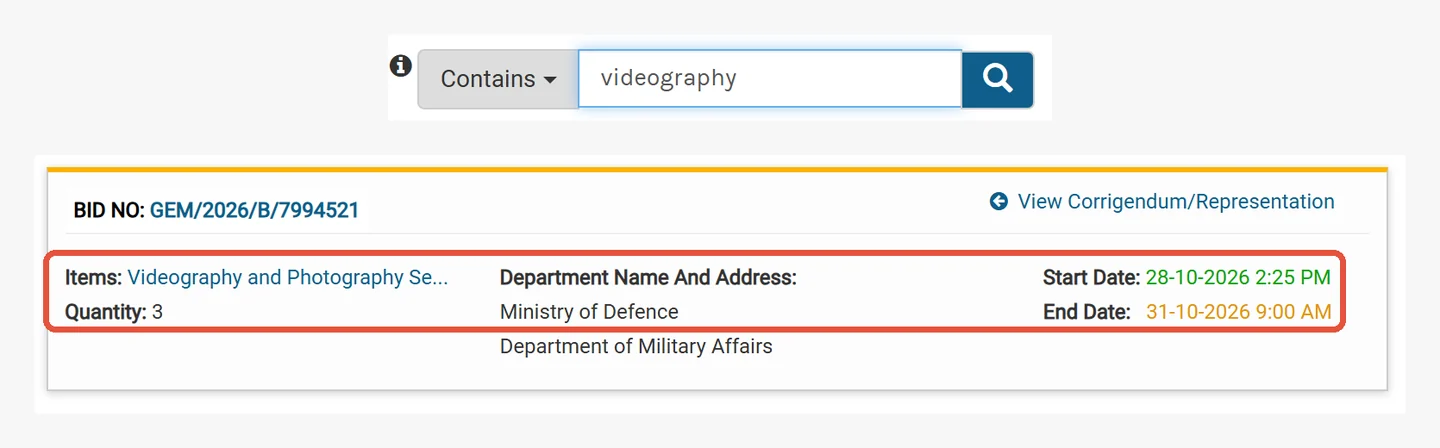
It isn't all hardware. In September the Department for Promotion of Industry and Internal Trade put out a ₹4 crore GeM tender for an agency to run its social media, the kind of media planning we also do as a programmatic advertising agency. On the day we counted live bids, a search for videography turned up 12, including one from the Ministry of Defence.
If you already make ads, videos or social content for fintech, gaming, ecommerce or subscription brands, you have the skills these buyers are asking for. What's different is the paperwork, and the way the work is won. It's the same craft we bring to app clients as an app growth agency, sold through a very different door.
Who can do GeM seller registration
Registration has to be done by an authorised person: the proprietor, a director of the company or a key person in the firm. GeM checks your details against tax records, so the person signing up should be the one whose name is on the business.
You'll pick your business type at the start, and the business PAN has to match it. GeM uses the fourth letter of the PAN to tell them apart.
| Business type | PAN to use | Fourth letter |
|---|---|---|
| Sole proprietorship | Your personal PAN | P |
| Partnership firm or LLP | The firm's PAN | F |
| Private or public limited company | The company's PAN | C |
| Trust, society or association | Its own PAN | T, A or B |
Swipe the table sideways to see every column.
A freelancer usually registers as a sole proprietorship, with their own PAN as the business PAN.
Documents to keep ready before you start
Gather these before you open the site. A common snag is a mismatch, a name spelled one way on Aadhaar and another way on PAN, so check them side by side first.
- Your Aadhaar number with the mobile number linked to it, or your personal PAN with its exact name and date of birth
- An active email address and a phone number
- The business PAN, the date your business was registered and, for a company, its CIN
- The full registered office address
- A bank account in the business's name, with its IFSC code
- A GSTIN, because without one you can't accept orders above ₹2.5 lakh
- Income tax returns for the last three years, if you want to take part in bids. You won't need them if the business is less than 24 months old, or if you'll only sell from a catalogue and skip bids
Two numbers are optional but worth having. An Udyam registration, free at udyamregistration.gov.in, marks you as a micro or small enterprise. A DPIIT number marks you as a recognised startup.
All of this comes from GeM's own prerequisites for seller registration. That sheet was last updated in 2020, so check the live portal for anything that's changed since.
The three stages on the portal, step by step
Registration starts on the GeM seller sign up page. It walks you through three stages, shown across the top of the page.
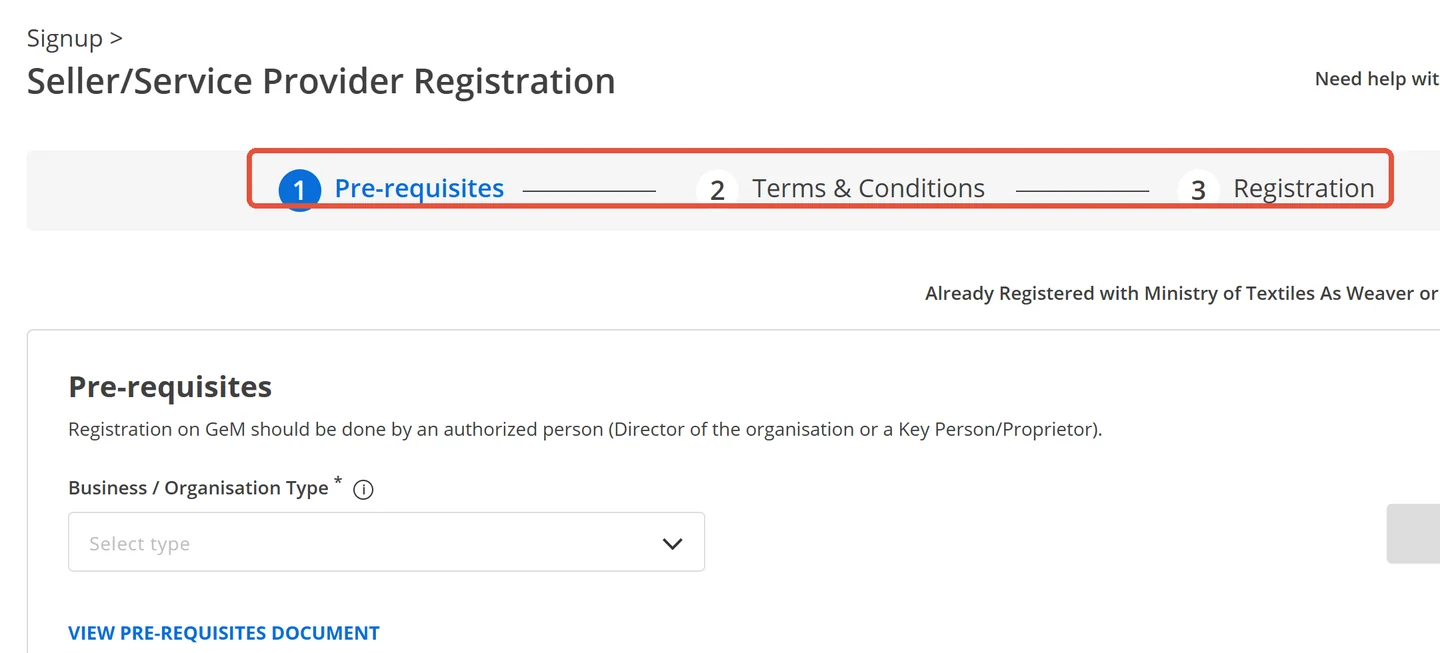
- Prerequisites. You choose your business or organisation type from the list and press Proceed. The page links to GeM's prerequisites sheet here too.
- Terms and conditions. You read and accept GeM's terms for sellers.
- Registration. You verify yourself with Aadhaar and the code sent to its linked mobile, or with your personal PAN, then add your email and mobile number to create the account.
Once the account exists, you finish the business profile: the business PAN and details, the office address, the bank account, GST and, if you plan to bid, your tax returns. Then you add the categories of goods or services you sell, so buyers and bids can find you.
We'll add screenshots of those later screens once our own GeM seller registration is through, with every number on them blurred.
After you register: finding your first bid
Bids are listed on GeM BidPlus, where you can search by keyword and filter by type. Search for the work you do, like videography, social media or printing, and read the bid document before you decide.
Start with small bids. Big tenders usually ask for a minimum turnover and past experience, and you won't have a GeM record yet. Some bids let recognised startups skip the turnover and experience rules. It's the buyer's choice, so look for it in the bid terms.
On payment, the rule is clear. Buyers must pay within 10 days of the receipt certificate, called the CRAC, and a buyer who pays late owes 1% a month in interest. That interest goes to a GeM fund, not to you, so it nudges buyers to pay on time without putting money in your pocket.
The honest catches
GeM isn't a shortcut, and we'd rather you hear that from us than find out halfway through a bid.
- The lowest price usually wins. Among the sellers who qualify, price decides most bids, so margins are thin.
- Experience counts. Larger tenders ask for turnover and similar past work, and that takes time to build.
- There's paperwork. Names, PANs, GST and tax returns all have to agree with each other.
- Payments can still run late. The 10 day rule helps, but plan your cash as if it won't always hold.
- The portal changes. GeM updates its screens and rules, so trust the live site over any guide, ours included.
Even so, a buyer that posts what it needs, in public, with a payment rule behind it, is worth an agency's time. You don't spend money on ads to find this client. That's the opposite of how we usually win work, which you can see in the campaigns we've run for brands.
Frequently asked questions
Do I need GST to register on GeM?
You can register without it, but GeM's own prerequisites say that without a GSTIN you can't accept orders above ₹2.5 lakh. If you plan to take on anything bigger, or to bid for agency work like social media or video, get your GST registration done before or alongside your GeM account.
Can a freelancer register as a seller on GeM?
Yes. A freelancer usually registers as a sole proprietorship, using their personal PAN, whose fourth letter is P, as the business PAN. You'll still need a bank account, an email address and, for orders above ₹2.5 lakh, a GSTIN. Registering as a micro enterprise through Udyam is free and worth doing too.
Do I need income tax returns to sell on GeM?
Only to take part in bids. GeM asks for income tax return details for the last three years, unless your business is less than 24 months old or is exempt from filing. If you only want to sell from a catalogue and skip bids, the returns aren't required, according to GeM's prerequisites sheet.
Can one person register more than one business on GeM?
Each business registers with its own PAN, so two proprietorships run on the same personal PAN count as one. Whether one person can be the main account holder for several companies isn't clear from GeM's published documents. We're checking with GeM while we register our own, and we'll update this answer.
When do government buyers pay on GeM?
Buyers must pay within 10 days of generating the receipt certificate, the CRAC, for what you delivered. A buyer who pays late owes 1% a month in interest, though that money goes to a GeM fund rather than to the seller. Delays still happen in practice, so keep some cash in reserve for the gap.
Is GeM worth it for a small agency?
It can be, if you go in with the right expectations. The lowest price usually wins and margins are thin, but the buyer comes to you and the payment rule is strict. Start with small bids, build a record on the platform, and treat the larger tenders as the goal for later.
Bidding for a government social media or ad tender? Talk to us
If you're putting together a bid for government social media, video or advertising work, we'll help you plan the scope, the creative and the media.
Start a conversation with Yori Labs